


On March 31, 2026, the research team led by Professor Chao Liu at the State Key Laboratory of Cognitive Neuroscience and Learning, Faculty of Psychology, Beijing Normal University, published a research paper titled "The self-interest of adolescents overrules cooperation in social dilemmas" in eLife. Focusing on the differences in cooperation between adolescents and adults during social interactions, the study combined behavioral experiments with computational modeling to systematically reveal the key psychological mechanism underlying adolescents' lower levels of cooperation: adolescents are not poor at judging whether others are willing to cooperate; rather, they assign lower intrinsic value to "reciprocal cooperation" in social interactions and are more readily driven by self-interested motives.
The eLife editorial team highly commended the academic significance of the study, deeming its findings "important" and the research methods rigorous, with solid experimental evidence. In addition, the eLife communications team prepared and released an official press release (https://elifesciences.org/for-the-press/15b3433b/why-teens-are-more-self-serving-than-adults-in-social-situations) and a scientific digest (https://elifesciences.org/digests/106840/teenagers-vs-teamwork) specifically for this study.
Cooperation is a cornerstone of human social development. Whether in peer interactions, teamwork, or the maintenance and construction of social order, individuals must constantly weigh "pursuing self-interest" against "promoting the common good." A substantial body of research has shown that adolescents generally exhibit lower levels of cooperation than adults. In the past, this phenomenon has often been attributed to adolescents' immature mentalizing functions or underdeveloped social cognitive abilities, leading to difficulty in accurately anticipating others' cooperative intentions.
However, this explanation remains contested. Existing evidence suggests that adolescents do not lack the capacity for cooperation; rather, they display a form of "selective non-cooperation." In particular, when faced with cooperative signals from others, they often fail to reciprocate in kind. This evidence directs the inquiry toward the core of the issue: Does this lack of reciprocity stem from an inability to accurately represent others' cooperative intentions, or does it reflect a decision-making process in which the weight of self-interested motives overrides the intrinsic reward of social reciprocity? To address this question, the research team employed an iterated Prisoner's Dilemma task to compare cooperative behavior between adolescents and adults in dynamic social interactions, and used computational models to further characterize the latent psychological processes involved.
At the behavioral level, the researchers found that adolescents' overall cooperation level was lower than that of adults, but this difference was not equally pronounced across all conditions. More specifically, the phenomenon of lower cooperation among adolescents primarily emerged when their interaction partner had previously chosen to cooperate; when the partner persisted in non-cooperation, both adolescents and adults reduced their cooperation levels, and the difference between the two groups was not significant. Further analysis revealed that adults gradually increased their probability of cooperation as their partner cooperated over multiple consecutive rounds, exhibiting a clear reciprocity-enhancement effect; adolescents, however, did not show the same trend. In other words, adolescents were just as capable as adults of recognizing and responding to others' non-cooperation, but when their partner consistently signaled goodwill, they did not significantly increase their cooperative reciprocation in the way adults did. This result suggests that adolescents' lower cooperation is not simply a matter of being "unable to adjust behavior according to the situation," but more likely reflects their lower valuation of reciprocal cooperation in social interactions.
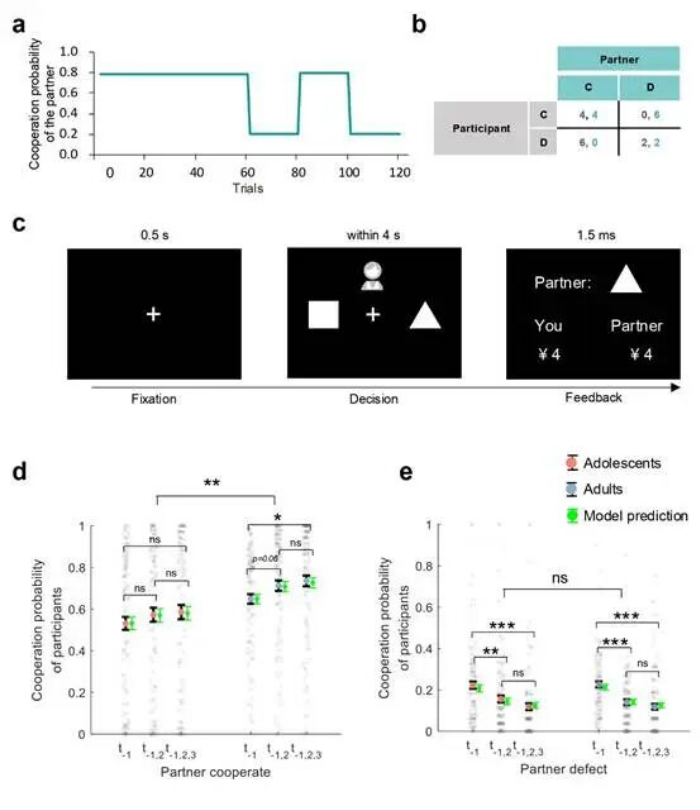
Figure 1. Experimental design and comparison of cooperative behavior between adolescents and adults
To further disentangle the different psychological mechanisms underlying adolescent cooperative behavior, the researchers constructed and compared multiple computational models. The results showed that an asymmetric reinforcement learning model based on social reward best accounted for the decision-making behavior of both adolescents and adults. According to this model, during multi-round social interactions, individuals update their expectations based on their partner's cooperative and uncooperative behaviors, and their decisions are simultaneously influenced by two key factors: their expectation of the partner's probability of cooperation, and the intrinsic reward derived from reciprocal cooperation.
Model analysis revealed no significant difference between adolescents and adults in forming expectations about others' cooperative intentions. Both the model-estimated cooperation expectations and participants' subjective judgments during the experiment regarding "how cooperative the other person was" were relatively similar across the two age groups. This indicates that adolescents' lower cooperation levels are not due to difficulty in recognizing others' willingness to cooperate, nor to a systematic underestimation of others' cooperative tendencies.
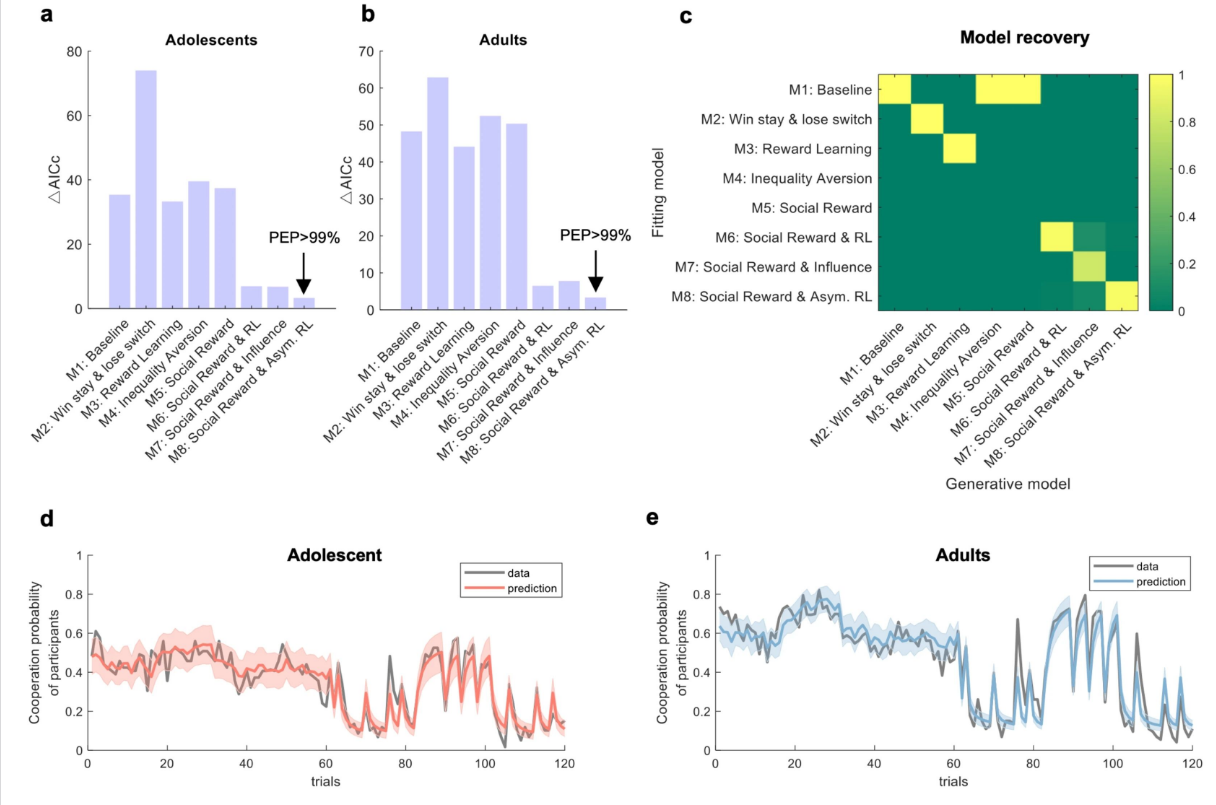
Figure 2. Cognitive computational modeling analysis of cooperative behavior in adolescents and adults
The real difference emerged in the value that individuals assigned to reciprocal cooperation itself. The study found that adolescents had an overall weaker social preference for cooperation, and the intrinsic reward derived from reciprocal behavior was significantly lower than that of adults. Notably, when their partner consistently exhibited cooperation, adults gradually increased their subjective valuation of reciprocal cooperation, whereas adolescents did not show a comparably pronounced enhancement trend. In other words, adolescents do not "fail to see" cooperation; rather, even when they perceive others' cooperation, they are not necessarily as willing as adults to reciprocate. In social dilemmas, they are more inclined to prioritize immediate individual gains over the social value embedded in long-term reciprocal relationships.
Further parameter analysis also revealed systematic differences between adolescents and adults in learning mechanisms. Compared with adults, adolescents had a higher positive learning rate, meaning they updated more rapidly in response to "better-than-expected" feedback; simultaneously, they had a lower negative learning rate, meaning they adjusted relatively more slowly to "worse-than-expected" feedback. In addition, adolescents exhibited weaker social preferences and higher value sensitivity, indicating that they were more readily driven by differences in immediate payoffs when making decisions. Taken together, adolescents do not lack basic social learning ability; on the contrary, they can effectively track feedback changes during interactions. They are simply more easily attracted by immediate benefits and, when faced with others' goodwill, are more inclined to first consider "whether they themselves can gain more" rather than "whether reciprocity should be maintained."
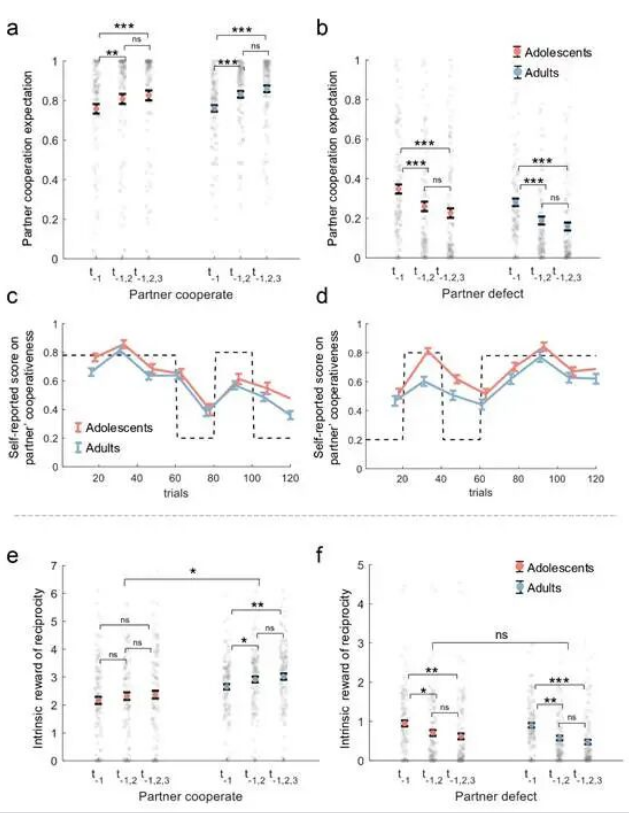
Figure 3. Comparison of cooperation expectations and reciprocity rewards between adolescents and adults based on model parameters
This finding holds important implications for rethinking the developmental mechanisms of cooperative behavior. For a long time, adolescents' lower cooperation has often been attributed to immature social cognition or theory of mind, but this study demonstrates that this explanation is insufficient. Adolescents and adults do not differ significantly in judging whether others are cooperative; what truly sets them apart is their differential valuation of the intrinsic worth of reciprocal cooperation. This study thus suggests that, in promoting cooperation and prosocial behavior among adolescents, beyond helping them understand others' intentions, greater attention should be paid to enhancing their appreciation of the value of fairness, reciprocity, and long-term social relationships. Overall, through the integration of behavioral experiments and computational modeling, this study provides new evidence for uncovering the developmental mechanisms of adolescent cooperative behavior and offers an important theoretical foundation for educational practice and socialization interventions.
Dr. Xiaoyan Wu, a former doctoral graduate of the research group (currently a postdoctoral researcher at the University of Zurich), and Hongyu Fu, a current doctoral student, are co-first authors of the paper. Professor Chao Liu is the sole corresponding author. In addition, Dr. Gökhan Aydogan, postdoctoral researcher at the University of Zurich; Associate Professor Chunliang Feng of South China Normal University; Professor Shaozheng Qin of the State Key Laboratory of Cognitive Neuroscience and Learning; and Professor Yi Zeng of the Institute of Automation, Chinese Academy of Sciences, also made important contributions to this study. This research was supported by the Science and Technology Innovation 2030—"Brain Science and Brain-Inspired Intelligence" Major Project (2021ZD0200500), the National Natural Science Foundation of China (32441109, 32271092, 32130045), and other funding sources.
Publication Information:
Wu, X.†, Fu, H.†, Aydogan, G., Feng, C., Qin, S., Zeng, Y., & Liu, C*. (2026). The self-interest of adolescents overrules cooperation in social dilemmas. eLife, 14, RP106840. https://doi.org/10.7554/eLife.106840.4