


Date: September 12, 2020
The research group has published its latest findings, "The dark side of gratitude: Gratitude could lead to moral violation," in the Journal of Experimental Social Psychology, unveiling the darker dimension of gratitude.
A substantial body of research has long sought to uncover the positive effects of gratitude, including promoting cooperation, increasing altruistic punishment, enhancing well-being, reducing deception, and curbing impulsivity. Numerous researchers have also been developing a variety of gratitude-based interventions aimed at alleviating symptoms of mental disorders by cultivating gratitude. Yet, the potential negative effects of gratitude have received little scholarly attention. For instance, if a colleague who once helped you move house is absent from work without leave, would gratitude prevent you from reporting them to your supervisor? Or, if a benefactor who once saved your life commits an illegal act, would gratitude lead you to shield them from the consequences?
Theoretically, the social function of gratitude is understood to help individuals strengthen their interpersonal relationships. If a conflict arises between strengthening a personal bond and adhering to social norms, how does gratitude influence behavior? Might gratitude lead beneficiaries to violate social norms more readily? The present study investigated this question through six experiments, combining both scenario-based and behavioral paradigms. The results showed that after gratitude was successfully induced, participants were significantly more willing to engage in transgressive behaviors—such as cheating or reducing deserved punishment—in order to protect their benefactor (see Figures 1, 2, and 3). Mediation analyses and computational modeling indicated that the desire to form a personal bond with the benefactor and the desire to avoid harming the benefactor were the primary motivations driving transgressive behavior among grateful participants.
The findings of this study reveal the potential dark side of gratitude and underscore that the social function of gratitude is to help individuals strengthen their interpersonal relationships. This discovery, on the one hand, contributes to a more comprehensive understanding of gratitude, and on the other, offers important implications for the normative application of gratitude-based interventions.
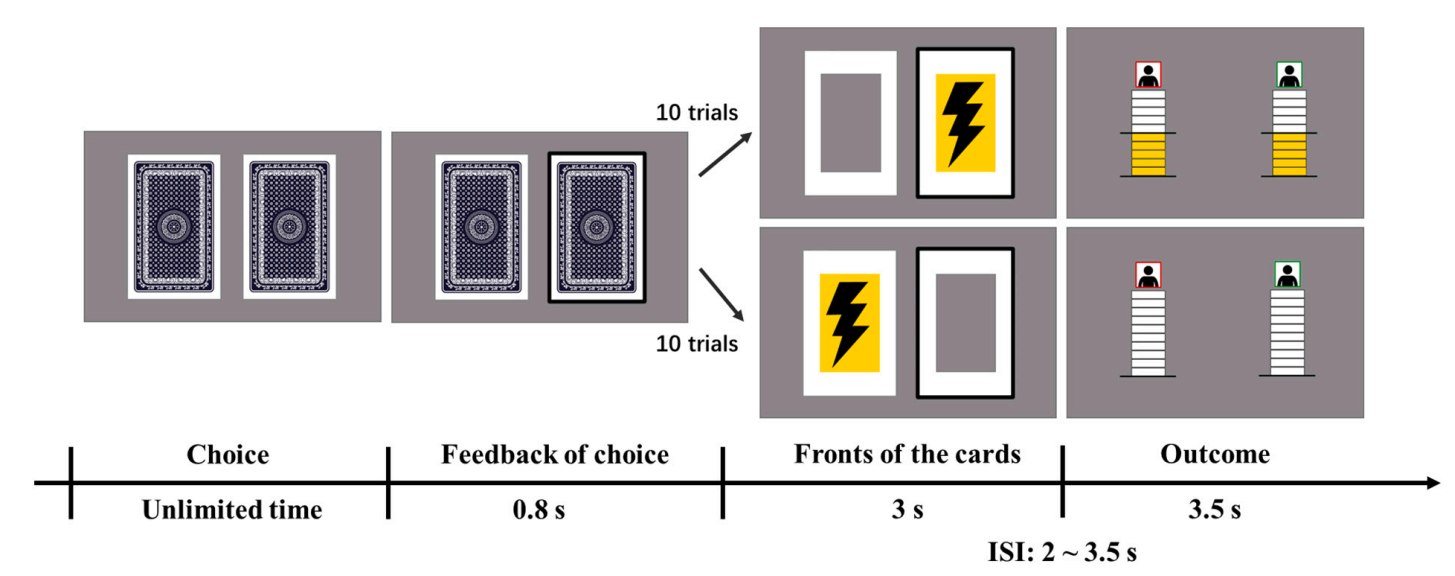
Figure 1. In the study, participants played a card-selection game with a partner. When a participant selected a blank card, neither the participant nor the partner received any consequence; when a participant selected a shock card, the participant faced the risk of receiving a strong, painful electric shock. At this point, the partner could choose whether or not to help share the shock. If the partner chose to help, both the participant and the partner would each receive a moderate-intensity shock; if the partner chose not to help, the partner would receive no shock while the participant would receive the full strong shock. Participants discovered during the game that every time they selected a shock card, the partner chose to help. This procedure was used to induce feelings of gratitude in participants. The participant is represented by the stick figure in the red box; the partner is represented by the stick figure in the green box.
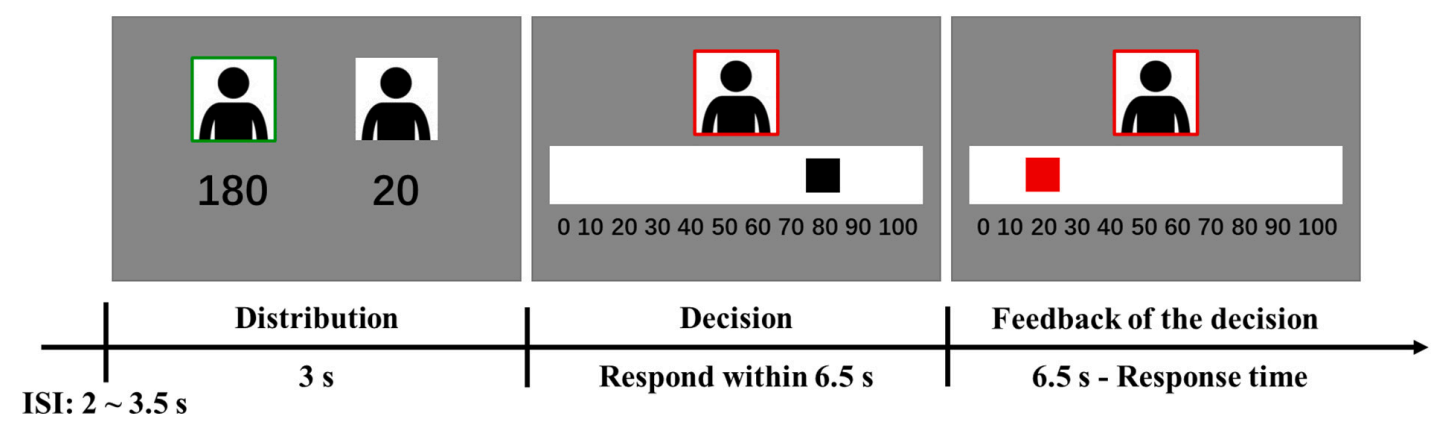
Figure 2. After gratitude induction, participants observed that their benefactor (the stick figure in the green box) made a series of monetary allocations between themselves and a stranger. Participants found that the benefactor's allocations were consistently unfair. Participants could decide whether to punish their benefactor. The benefactor's allocations did not affect the participant's own interests, and the participant's punishment did not incur any economic cost to themselves. This paradigm was designed to examine whether gratitude reduces participants' willingness to punish their benefactor. The stranger is represented by the stick figure in the green box.
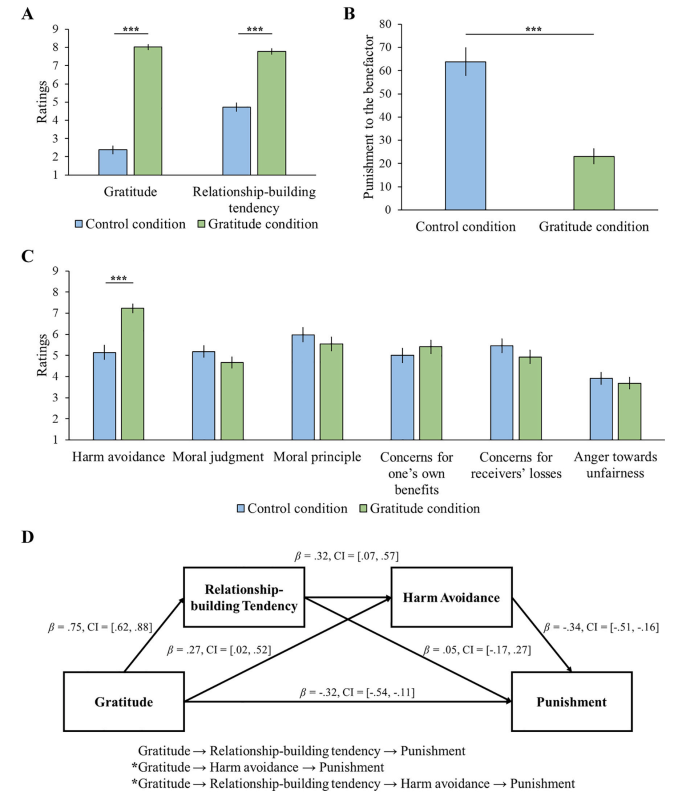
Figure 3. (A) Participants in the gratitude condition reported stronger feelings of gratitude and a greater tendency to form a friendship with the benefactor. (B) When the benefactor behaved inappropriately toward a stranger, participants in the gratitude condition administered less punishment to the benefactor. (C) Participants in the gratitude condition showed a stronger desire to avoid harming the benefactor's interests. (D) Gratitude ultimately influenced participants' punitive behavior through the mediating pathways of friendship tendency and harm avoidance.
Drs. Ruida Zhu and Zhenhua Xu are co-first authors of the paper. Professor Chao Liu is the corresponding author.
Publication Information: Zhu, R., Xu, Z., Tang, H., Wang, H., Zhang, S., Zhang, Z.,Mai, X., & Liu, C. (2020). The dark side of gratitude: Gratitude could lead to moral violation. Journal of Experimental Social Psychology, 91, 104048. [PDF]