


(I) Paper Summary
In December 2025, a research team from the Department of Psychology at Sun Yat-sen University and other institutions published a research paper titled "Human neurocomputational mechanisms of guilt-driven and shame-driven altruistic behavior" in eLife (a CAS Category 1 top-tier journal). The eLife editorial team highly commended the academic significance of the study, deeming its findings "important" and the strength of its evidence "compelling." In addition, the eLife communications team prepared and released a press release specifically for this study (https://elifesciences.org/for-the-press/0e8faebe/scientists-unravel-neural-networks-that-guide-guilt-and-shame-driven-behaviours).
(II) Research Background
During social interactions, when individuals cause harm to others through their own actions, they often experience a range of moral emotions and adjust their subsequent behavior accordingly. Among these, guilt and shame (also referred to as "loss of face") are regarded as two core moral emotions, widely implicated in norm compliance, cooperation, apology, and compensatory behavior. Although the two emotions frequently co-occur following moral transgressions, a large body of psychological research has demonstrated that they differ in their cognitive appraisals, motivational orientations, and behavioral consequences (Haidt, 2003; Tangney & Dearing, 2003).
Existing research indicates that guilt focuses more on the harmful consequences of one's actions for others, whereas shame focuses more on one's self-image and how one is evaluated in the eyes of others. This functional divergence suggests that guilt and shame may serve distinct adaptive problems: guilt motivates individuals to repair wrongful harm done to others, while shame helps individuals avoid social devaluation and reputational damage (Landers et al., 2024; Sznycer, 2019). Yet, which cognitive factors respectively trigger guilt and shame? How are these emotions subsequently translated into concrete compensatory altruistic behavior? The underlying computational neural mechanisms have remained unclear.
Notably, in real-world social contexts, moral transgressions often involve both the degree of harm and the degree of responsibility. When multiple individuals jointly cause an adverse outcome, how individuals integrate these two types of information, thereby generating different intensities of guilt or shame and further influencing compensatory decisions, constitutes a key question in moral emotion research. To address this gap, there is a pressing need to combine neuroimaging and computational modeling approaches to systematically uncover, at the mechanistic level, the processes underlying the formation and behavioral translation of guilt and shame.
(III) Results and Discussion
At the behavioral level, the researchers first found that both the degree of harm and the level of responsibility significantly intensified individuals' experiences of guilt and shame. However, a more fine-grained analysis revealed that the effects of these two cognitive factors on emotion were asymmetric: the effect of harm on guilt was significantly stronger than its effect on shame, whereas the effect of responsibility on shame was significantly stronger than its effect on guilt (Figure 1). This result provides direct validation, within a single experimental framework, of a core prediction of functionalist theories: guilt is more sensitive to the actual harm one has caused to others, while shame is more sensitive to the responsibility one bears within the social evaluative system. Further analysis of compensatory behavior revealed that while both guilt and shame promoted compensatory altruistic behavior, the effect of guilt on compensation was significantly stronger than that of shame. This difference did not stem from a difference in the intensity of the two emotional experiences, but rather reflected a fundamental distinction in their behavioral translation efficiency.
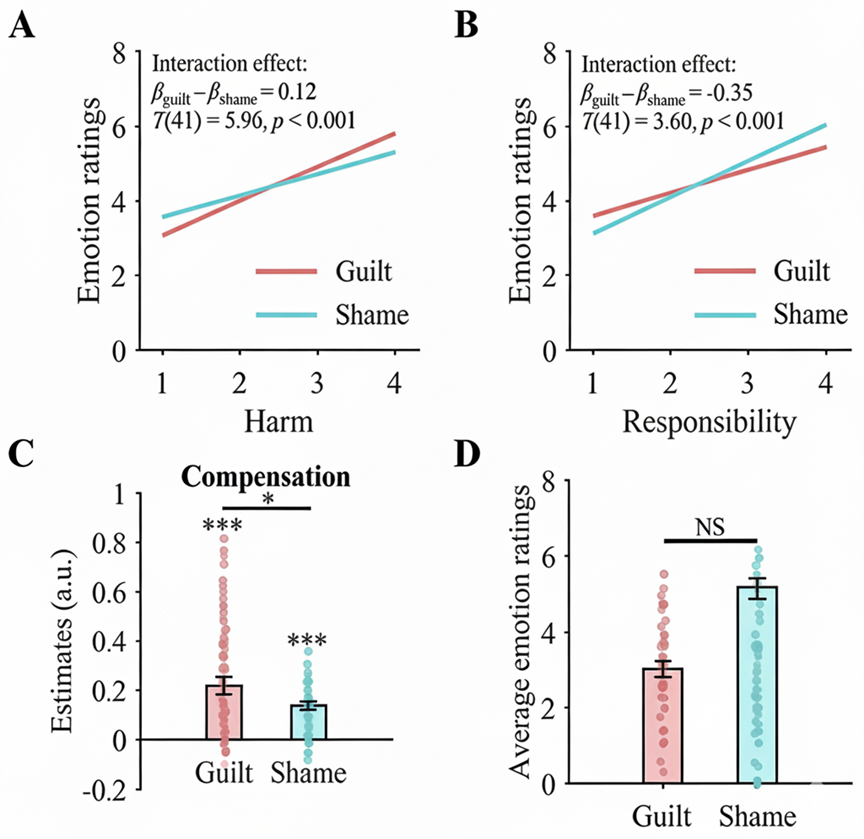
Figure 1. (A) Compared with shame, harm had a stronger effect on guilt. (B) Compared with guilt, responsibility had a stronger effect on shame. (C) Compared with shame, guilt had a greater effect on compensatory behavior. (D) There was no significant difference in the overall intensity of guilt and shame experiences reported by participants.
In terms of computational modeling, to characterize the latent psychological computational processes underlying compensatory decision-making, the researchers constructed and compared multiple computational models. The results showed that the best-fitting model assumed that individuals integrated information in the form of "harm ÷ number of responsible persons"—that is, they estimated the "average harm per responsible person." The modeling results further indicated that during compensatory decision-making, individuals tended to disregard their own economic interests and adjusted their behavior around a subjective "compensation baseline."
At the neural level, the study found that the striatum and posterior insula represented this integrated index of "average responsibility-weighted harm." Regarding emotion-specific sensitivity, the tendency to convert responsibility information into shame was closely associated with activity in brain regions linked to theory of mind, specifically the temporoparietal junction and the superior temporal sulcus. With respect to the neural basis of compensatory behavior, the dorsomedial prefrontal cortex was involved in both guilt-driven and shame-driven compensatory decision-making. Notably, the left lateral prefrontal cortex was more strongly engaged in shame-driven compensatory behavior, suggesting that shame-related compensation may involve more strategic deliberation.
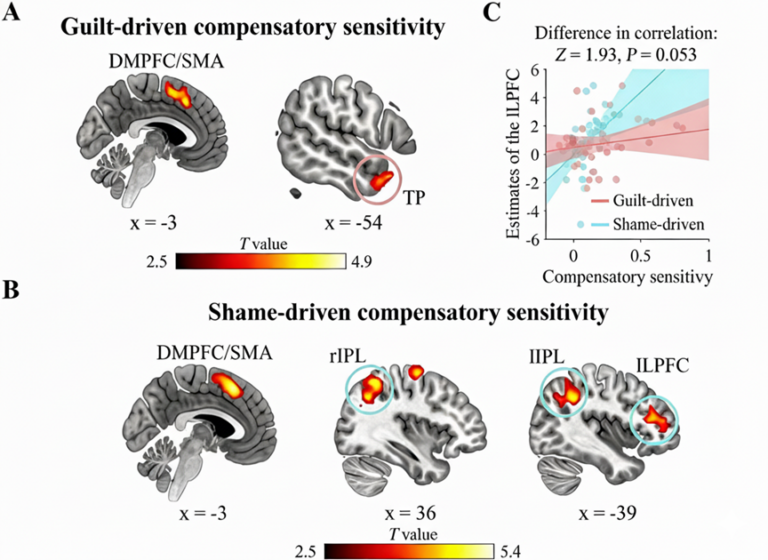
Figure 2. (A) Activity in the dorsomedial prefrontal cortex, supplementary motor area, and temporal pole was significantly correlated with guilt-driven compensatory sensitivity. (B) Activity in the dorsomedial prefrontal cortex, supplementary motor area, bilateral inferior parietal lobules, and left lateral prefrontal cortex was significantly correlated with shame-driven compensatory sensitivity. (C) The left lateral prefrontal cortex showed a trend toward a stronger positive correlation with shame-driven compensatory sensitivity than with guilt-driven compensatory sensitivity.
(IV) Discussion and Outlook
In summary, through the integrated use of behavioral experiments, computational modeling, and neuroimaging, this study systematically revealed the differences between guilt and shame at the levels of cognitive antecedents, computational mechanisms, and neural implementation. The findings validate core assumptions of functionalist theories of moral emotions. It should be noted that this study was primarily based on healthy adult samples and that the measurement of emotional experience relied on retrospective self-report. Future research could employ real-time emotion measurement, brain stimulation techniques, or developmental samples to further examine the causality and generalizability of the relevant mechanisms. Nonetheless, this study provides important insights into how moral emotions shape social behavior and holds potential implications for interventions targeting guilt and shame in psychological disorders, moral education, and the design of social norms.
(V) Link to the Original Paper
https://doi.org/10.7554/eLife.107223
(VI) Author Information
The first author of the paper is Associate Professor Ruida Zhu of Sun Yat-sen University, and the corresponding author is Professor Chao Liu of Beijing Normal University. Other authors include Dr. Huanqing Wang of The Ohio State University, Associate Professor Chunliang Feng of South China Normal University, Master's student Linyuan Yin of Sun Yat-sen University, Master's student Ran Zhang of Beijing Normal University, and Research Fellow Yi Zeng of the Institute of Automation, Chinese Academy of Sciences. This research was supported by the Science and Technology Innovation 2030 Major Project (2021ZD0200500), the National Natural Science Foundation of China (32200884, 32441109, 32271092, 32130045), and other funding sources.
References
Haidt, J. (2003). The moral emotions. In R. J. Davidson, K. R. Scherer, & H. H. Goldsmith (Eds.), Handbook of affective sciences (pp. 852–870). Oxford University Press.
Landers, M., Sznycer, D., & Durkee, P. (2024). Are self-conscious emotions about the self? Testing competing theories of shame and guilt across two disparate cultures. Emotion, 24(5), 1–12. https://doi.org/10.1037/emo0001321
Sznycer, D. (2019). Forms and functions of the self-conscious emotions. Trends in Cognitive Sciences, 23(2), 143–157. https://doi.org/10.1016/j.tics.2018.11.007
Tangney, J. P., & Dearing, R. L. (2003). Shame and guilt. Guilford Press.